Planning a Herzing Preceptorship Across Alaska
Alaska gives nurse practitioners full practice authority, but distance and a small provider pool make placement planning unusually local. Herzing students should pair early outreach with a realistic plan for travel, site review, and course fit.
Get matched, free
Tell us your track and city. No payment until you’re matched with a preceptor.
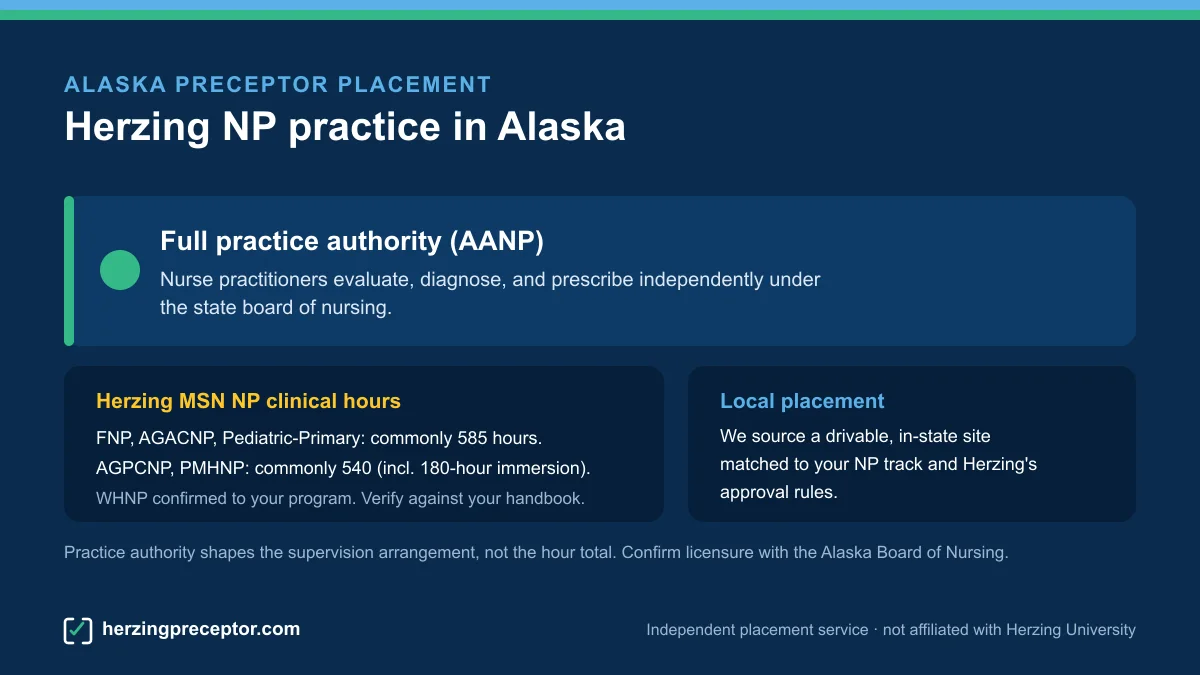
Full practice authority across a very large state
AANP classifies Alaska as a full practice state. Licensed nurse practitioners may evaluate patients, diagnose, order and interpret tests, and manage treatment, including prescribing, under the authority of the Alaska Board of Nursing. State law does not require a physician collaboration or supervision agreement for ordinary NP practice.
That independence is especially visible outside the main cities. An NP may own a practice, manage a patient panel, or serve as an advanced clinician in a community where specialist access requires travel. Full practice authority expands the possible preceptor pool because an experienced NP does not need a physician agreement simply to practice or consider hosting a learner.
Students still practice under supervision. State authority describes what a licensed NP may do, while a Herzing practicum requires an approved site, an approved preceptor, direct teaching, and experiences aligned with the course. The clinician's national certification, patient population, license, and daily responsibilities remain more important than the full practice label alone.
Verify the clinician through the Alaska Board of Nursing
The Alaska Board of Nursing operates within the state professional licensing system. It handles RN and advanced practice licensing, public verification, prescribing authority, renewal, and discipline. Its official pages are the place to confirm a prospective preceptor's current standing and to check state requirements that may have changed since a colleague completed a rotation.
A clear license is only the opening screen. Herzing reviews the clinician and site for the specific course, and the application generally includes a preceptor CV plus a signed agreement. Ask whether the site can provide appropriate patients, supervision, records access, and enough scheduled clinical time during your dates.
- Check the license before requesting site paperwork
- Match national certification and population focus to the clinical course
- Ask about organization credentialing and affiliation lead times
Build an island, road, or hub-specific search
Anchorage offers the broadest mix of hospital-associated clinics, independent practices, and behavioral health providers. Wasilla and Palmer add options in the Mat-Su Valley, while Fairbanks, Juneau, Soldotna, Kenai, and Homer serve distinct regional markets. Bethel, Nome, Kotzebue, Sitka, and Ketchikan have experienced clinicians, but each hub may depend on a small number of organizations.
A statewide mileage radius is not a practical Alaska search plan. Weather, ferries, flights, temporary housing, and concentrated work schedules can matter as much as map distance. A student in Southeast Alaska needs a different plan from one on the road system, and a rotation requiring hospital acuity will have fewer possible sites than an outpatient primary care course.
Tribal health organizations and community health centers are important training settings, yet large systems may require affiliation review and credentialing that take time. Independent practices can sometimes decide more quickly. We assess physical placement options and an eligible virtual preceptorship route, then search where the course, schedule, and geography can actually meet.
Put the Herzing process on the same calendar as travel
Herzing encourages a student to identify a preceptor and site. The school supports that work through a Clinical Placement Advisor, a master's-prepared Clinical Coordinator, and an approved-site fallback list. Once a clinician is interested, Herzing evaluates the proposed experience under the current course and program requirements.
Eligible students may use the conditional APRN Clinical Placement Pledge as a placement backstop. The student must complete required steps, meet deadlines, and start the formal placement process at least two months before the clinical application deadline. The clinician and site still have to satisfy approval standards. Alaska students should begin even earlier when an affiliation, flight plan, or temporary stay may be involved.
We handle focused outreach to clinicians whose specialty, population, location, and dates fit the request. The student receives a candidate to take through Herzing's review, and payment is due only after the placement is secured. For service details and current pricing, use how it works and the cost page.
Keep published hours in context
Herzing offers six MSN NP tracks: FNP, AGACNP, AGPCNP, PMHNP, PNP-PC, and WHNP. FNP, AGACNP, and PNP-PC commonly publish 585 clinical hours. AGPCNP and PMHNP commonly publish 540, including a 180-hour immersion. These are planning figures, so confirm the current handbook and your individual plan. Confirm WHNP requirements directly rather than assigning it another track's hour total.
Coursework may be online, but the supervised practicum is normally in person at a Herzing-approved site. Alaska's use of telehealth can make virtual encounters relevant, especially where travel is difficult, but acceptance depends on the Herzing program, the course, the site, state rules, and the type of patient experience. Our physical and virtual placement routes preserve both options while the school decides what can count.
Before arranging travel, confirm that Herzing currently permits enrollment and practicum activity for your track in Alaska. Treat the CV, signed agreement, site review, credentialing, and travel booking as separate milestones. A verbal yes from a clinician is useful, but it is not permission to start clinical hours.
Get a realistic Alaska search assessment
If your local provider list is short or every organization is already committed, submit a free placement review. Include your home community, track, course dates, ability to travel, preferred schedule, and whether an eligible virtual component could work so the search can be assessed in practical terms.
The strongest Alaska placement plan respects both clinical requirements and logistics. It identifies who can teach the right patient population, how the student will consistently attend, and how much review time the organization and Herzing will need before the first scheduled day.
Good to know
Is Alaska a full practice authority state?
Yes. Alaska NPs practice under the Alaska Board of Nursing without a state-mandated physician collaboration agreement. A student still needs direct supervision by a Herzing-approved preceptor at an approved site.
Where are Alaska NP preceptors most concentrated?
Anchorage has the largest provider pool. The Mat-Su Valley, Fairbanks, Juneau, the Kenai Peninsula, and regional hubs also offer possibilities, but travel and organization-specific onboarding can shape availability.
Can telehealth help with an Alaska Herzing practicum?
It may be part of an approved experience when the program, course, site, Alaska rules, and patient encounters permit it. Confirm the arrangement with Herzing before relying on virtual hours.
How early should an Alaska student begin placement work?
Begin well before the clinical application deadline. The Pledge process requires eligible students to start formally at least two months before that deadline, and Alaska travel, affiliation, or credentialing needs can justify more time.
Get matched with a
Herzing-approvable preceptor
Tell us your track, your city, and your clinical application deadline. We'll reply with a placement plan and a realistic path to clearing it.