PMHNP Preceptor Placement for Herzing Psychiatric-Mental Health NP Students
Last updated July 2026 · Reviewed against Herzing University's current NP program pages.
The Psychiatric-Mental Health Nurse Practitioner track puts you on the front line of a national mental-health shortage, which is exactly why the preceptors who can train you are so hard to find. Herzing's PMHNP program expects you to take an active role in lining up your own clinical site, and the clinicians qualified to supervise psychiatric care are among the scarcest in nursing education. We are an independent service that helps Herzing PMHNP students source a qualified, Herzing-approvable preceptor early enough to clear the program's deadlines and approval steps. We are not Herzing University and we do not speak for it; this page explains the PMHNP practicum, who can precept you, and how we help you secure that placement before the conditional backstop ever becomes relevant.
Get matched, free
Tell us your track and city. No payment until you’re matched with a preceptor.
What the Herzing PMHNP track asks of you
The Herzing MSN Psychiatric-Mental Health Nurse Practitioner track prepares you to assess, diagnose, and treat mental-health and substance-use conditions across the lifespan, from young children to older adults. Coursework is delivered 100% online, and your clinical learning happens in person at a Herzing-approved site under a qualified preceptor. At the MSN level the curriculum is built on semester credits (commonly 48 credits for the MSN), and a post-master's APRN certificate in the PMHNP specialty is also available if you already hold NP preparation in another population focus.
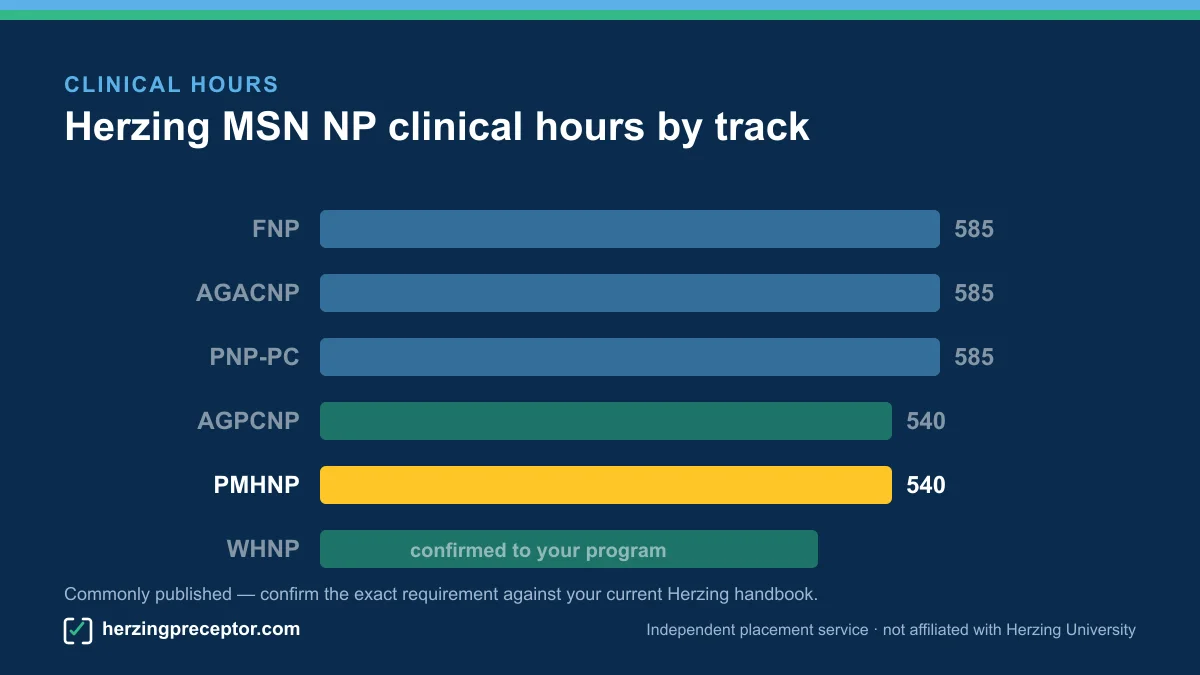
The PMHNP practicum is commonly published at 540 clinical hours, and the program structure is notable for including a 180-hour, 16-week clinical immersion as part of that total. These figures are commonly published for this program; we confirm the exact requirement against your current Herzing handbook before we build your plan, because the number that governs your graduation is the one in the handbook you are enrolled under, not a figure on any website. If you are in the BSN-to-DNP or MSN-to-DNP pathway with a psychiatric focus, expect additional doctoral practice hours and a DNP Practice Project layered on top of the master's-level clinical requirement.
Across all of those hours, you are expected to log your activity in your program's clinical tracking system, and you will need to clear a background check and immunization clearance before you can begin seeing patients. The detailed hour breakdown for every Herzing NP track lives on our clinical hours page so we keep one authoritative version of those numbers.
What psychiatric care across the lifespan means for your placement
The lifespan scope is the defining feature of the PMHNP role, and it shapes who can precept you. To graduate ready for board certification you need experience that spans children and adolescents, adults, and older adults, and that touches the full range of psychiatric practice: diagnostic interviewing and mental-status assessment, psychopharmacology and medication management, psychotherapy or therapeutic communication within your scope, crisis and risk assessment, and care for co-occurring substance-use disorders.
In practice, few single preceptors cover every one of those settings, so a strong PMHNP plan often combines more than one site or preceptor over your terms; for example, an outpatient psychiatry or community mental-health clinic for adult medication management paired with a child-and-adolescent or addiction-focused rotation for the population breadth your program wants. We map your requirement to the populations and settings you still need before we approach anyone, so the placements you secure actually add up to the experience the program is looking for rather than leaving a lifespan gap you discover late.
Where PMHNP students typically train
- Outpatient psychiatry and behavioral-health clinics (medication management, follow-up care)
- Community mental-health centers serving mixed and underserved populations
- Inpatient and partial-hospitalization psychiatric units
- Substance-use and addiction-treatment programs
- Child, adolescent, and geriatric mental-health settings for lifespan breadth
- Integrated primary-care and telepsychiatry practices, where your program allows them
Who can serve as your PMHNP preceptor
A PMHNP preceptor has to be qualified for the psychiatric scope you are learning, not just any advanced-practice clinician. In practice that means a board-certified Psychiatric-Mental Health Nurse Practitioner or a psychiatrist practicing within psychiatric scope. The point is that your supervising clinician must be credentialed to diagnose and treat mental-health conditions and to oversee psychiatric care, so that the hours you log reflect genuine psychiatric training.
Beyond the clinical credential, every preceptor and site has to be Herzing-approved. Approval typically requires the preceptor's CV and a signed preceptor agreement, and the site has to meet the program's standards. A clinician can be excellent and still not clear approval if the paperwork is incomplete or arrives late, which is why we handle the documentation alongside the introduction rather than leaving you to chase a busy psychiatrist for a CV weeks before a deadline. Your final eligibility rules come from your Herzing handbook and your Clinical Coordinator; we line up candidates that fit those rules and prepare them for the formal approval your program runs. The clinical compliance page walks through the documentation and clearances in full.
Telepsychiatry, where your program allows it
Psychiatry is one of the most telehealth-friendly specialties, and telepsychiatry can meaningfully widen the pool of preceptors available to you, which matters when local psychiatric preceptors are thin. Whether telepsychiatry hours count toward your practicum, and in what proportion, is determined by your program and the licensure rules in your state, not by us. We will pursue telepsychiatry options when your program permits them, and we confirm what is allowed against your handbook before treating a remote rotation as part of your plan.
Why psychiatric preceptors are scarce, and how we work around it
PMHNP enrollment has grown faster than almost any other NP specialty, while the number of practicing psychiatric providers willing and able to precept has not kept pace. The clinicians who can supervise you are in high demand for patient care, many practices cap how many students they take, and a single psychiatrist may already be precluded from precepting if they are committed to other learners. That mismatch is the real reason psychiatric placements fall through, and it is the reason starting early matters more here than in almost any other track.
Our response is to begin sourcing in your specialty and state well ahead of your clinical start, cast a wide enough net to absorb the inevitable declines, and pursue telepsychiatry-eligible preceptors where your program allows. We approach clinicians with the documentation requirements already understood, so a willing preceptor can clear Herzing's approval cleanly instead of stalling on paperwork. The detail of how we find and vet candidates is on our find a preceptor page, and the broader process is laid out under how it works.
We are honest about why this is hard, and honest about what we do and do not control. We secure introductions and prepare approval materials; your program runs the official approval. We do not guarantee a specific clinician, and we never imply a Herzing relationship we do not have.
Herzing's Pledge is real, but conditional
Herzing is genuinely student-first about clinical placement. You are expressly encouraged to identify and secure your own site and preceptor, with support from a Clinical Placement Advisor and a master's-prepared Clinical Coordinator, plus an approved-site fallback list if your own outreach comes up empty. Herzing's APRN Clinical Placement Pledge goes a step further: if, after you complete all required steps and start early enough, you still cannot secure a placement, Herzing says it will step in and secure it for you.
The catch is in the conditions. The Pledge is reactive and deadline-gated: it only applies if you follow the Clinical Guidance Process, meet every deadline, and begin the formal placement process well before your clinical application deadline, and any site or preceptor still has to be Herzing-approved with a CV and signed agreement on file. For PMHNP students that window is the riskiest part of the timeline, because psychiatric preceptors are exactly the kind that take longest to find. Our honest wedge is simple: we get a qualified, approvable PMHNP preceptor lined up early so you clear Herzing's own deadlines and approval requirements on your terms, rather than gambling on a conditional backstop that activates only after you have already done everything right and run out of time. The full Pledge terms live on our clinical placement page, and the exact deadline math is on clinical deadlines.
One thing the Pledge is not: it is not a tuition refund or a money-back guarantee. It is a placement backstop. There is no Herzing tuition-refund promise tied to clinical placement, and we will never tell you otherwise.
How we help Herzing PMHNP students
We focus on the gap between Herzing's student-first model and the reality of finding a scarce psychiatric preceptor under a hard deadline. Practically, that looks like this:
- We confirm your exact PMHNP requirement, including the immersion, against your current Herzing handbook before we start.
- We map the populations and settings you still need across the lifespan so your hours add up to the experience your program expects.
- We source board-certified PMHNP or in-scope psychiatrist preceptors in your state, early, including telepsychiatry options where your program allows them.
- We prepare the approval package, preceptor CV and signed preceptor agreement, so your candidate clears Herzing's process without last-minute scrambling.
- We keep you ahead of the formal-placement window so you never have to rely on the conditional Pledge.
If you want to see the populations and tracks we cover, our specialties overview lists every Herzing NP focus. When you are ready, tell us your track, your state, and your clinical start date through our contact page and we will start sourcing.
Herzing PMHNP practicum at a glance
These are the figures Herzing commonly publishes for the Psychiatric-Mental Health track. Treat the hours as planning numbers and confirm them against your current handbook, and note that the 2022 National Task Force standards set a national minimum of 750 supervised direct-patient-care hours, so program totals can change over time.
| Detail | Herzing PMHNP practicum |
|---|---|
| Commonly published clinical hours | 540 |
| Clinical immersion | 180 hours across 16 weeks, within the total |
| Program level | MSN, plus post-master's APRN certificate option |
| Approvable preceptor | Board-certified PMHNP, or an in-scope psychiatrist |
| Patient scope | Psychiatric-mental health across the lifespan |
| Site and preceptor approval | Required before you attend, by Herzing |
| Accreditation | CCNE, Herzing University-Madison |
Sources: Herzing University, MSN-PMHNP program; Herzing University, NP clinicals overview; Herzing University, Clinical Placement Pledge and Guidance Process; NCSBN, APRN Consensus Model (LACE). Last verified July 2026.
Good to know
How many clinical hours does the Herzing PMHNP track require?
It is commonly published at 540 hours, which notably includes a 180-hour, 16-week clinical immersion. We treat those as commonly published figures and confirm the exact requirement against your current Herzing handbook, since the number that governs your graduation is the one in your enrolled program's handbook. See our clinical hours page for the full per-track breakdown.
Who is allowed to be my PMHNP preceptor?
A board-certified Psychiatric-Mental Health Nurse Practitioner or a psychiatrist practicing within psychiatric scope, credentialed to diagnose and treat mental-health conditions. The preceptor and site also have to be Herzing-approved, which typically requires the preceptor's CV and a signed preceptor agreement. Your handbook and Clinical Coordinator set the final rules; we line up candidates that fit them.
Can I do telepsychiatry hours for my PMHNP practicum?
Sometimes. Telepsychiatry can widen the pool of available preceptors, but whether remote hours count, and in what proportion, is decided by your program and your state's licensure rules, not by us. We pursue telepsychiatry-eligible preceptors where your program allows them and confirm what is permitted against your handbook first.
Why are psychiatric preceptors so hard to find?
PMHNP enrollment has grown faster than the supply of clinicians able and willing to precept. Qualified psychiatric providers are in heavy demand for patient care, many cap student loads, and some are already committed to other learners. That scarcity is why we start sourcing early and cast a wide net rather than waiting on a single contact.
Doesn't Herzing already promise to place me?
Herzing's APRN Clinical Placement Pledge is real, but it is conditional and reactive. It only steps in after you have completed every required step, met all deadlines, and begun the formal placement process early enough, and only for Herzing-approved sites. It is a placement backstop, not a tuition refund. We help you secure a preceptor early so you clear those conditions instead of relying on the backstop. See our clinical placement page for the full terms.
Are you part of Herzing University?
No. We are an independent clinical-placement service for Herzing PMHNP and DNP students. We help you source a Herzing-approvable preceptor; your program runs the official approval.
Get matched with a
Herzing-approvable preceptor
Tell us your track, your city, and your clinical application deadline. We'll come back with a placement plan and a realistic path to clearing it.