What Makes a Preceptor Herzing-Approvable?
Last updated July 2026 · Reviewed against Herzing University's current NP program pages.
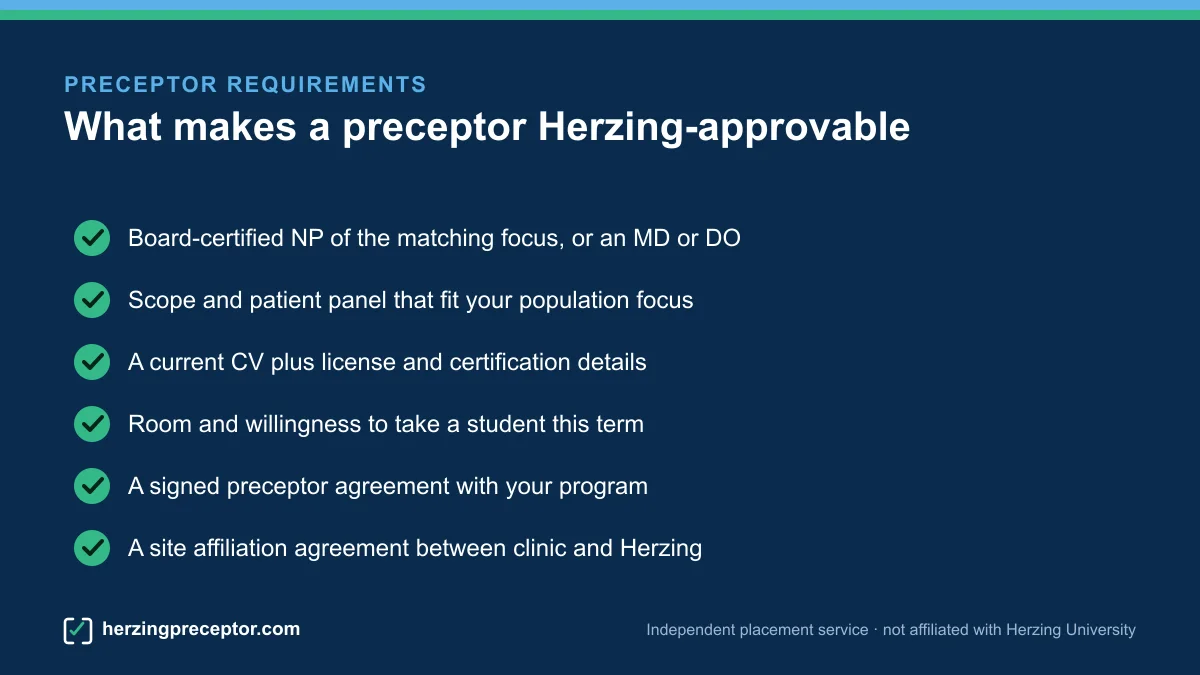
A Herzing-approvable preceptor is a licensed clinician in your specialty, at a site Herzing will approve, who will hand over a current CV and sign the preceptor agreement in time for your clinical application. That definition matters because at Herzing the school's approval is the requirement: every site and every preceptor must be Herzing-approved, and a clinician who looks perfect on paper but never clears that process gives you zero hours. This guide works through approval the way the school does, the file your application needs, the signals a candidate will clear, who fits each of the six NP tracks, and the date by which it all has to be locked in. We are an independent clinical rotation placement service, not Herzing University, so confirm every criterion against your current Herzing handbook and your Clinical Placement Advisor.
Get matched, free
Tell us your track and city. No payment until you’re matched with a preceptor.
Approval is the requirement, so start from Herzing's process
The single most important thing to understand is that Herzing does not simply accept whichever clinician you find. Under its student-first model you are expected to take an active role in identifying your own site and preceptor, supported by a Clinical Placement Advisor and a master's-prepared Clinical Coordinator, and everything you propose then runs through Herzing's own approval: the site, the preceptor, and the paperwork, as part of the Clinical Guidance Process.
That changes how you should search. The question is never just "will this clinician teach me?" but "will Herzing approve this clinician, at this site, in time for my application?" A slightly less convenient candidate who clears approval beats a perfect-seeming one who cannot. It also means your advisor is not an obstacle, they are the referee you want involved early, before you have spent a month courting someone who was never going to clear. The full picture of how the student-first model and the Placement Pledge fit together is on our clinical placement guide.
The approval file: what your application cannot be complete without
Herzing's clinical application is only complete when the preceptor's file is, and two documents anchor it.
- The preceptor's current CV. This is how the school verifies who is supervising you. Ask for it at the first yes, not the last minute, because a busy clinician's CV can take weeks to surface, and an outdated one bounces back for revisions.
- The signed preceptor agreement. The formal commitment to supervise you. Unsigned, your application is not submitted, and the deadline keeps running while you chase the signature.
- Site details for approval. Enough about the practice for Herzing to approve it as a clinical site.
- Your own clearances. Background check and immunization clearance travel with the application, see clinical compliance.
Treat the file like the placement itself, because functionally it is. In our experience the paperwork, not the willingness, is what most often decides whether a start date holds, and it is the piece students leave until last because it feels administrative. It is not administrative. It is the application.
Six signals a candidate will clear approval
Herzing's criteria are the ones that decide, and they live in your current handbook, but these are the signals we screen for before we put a candidate in front of the process:
- A license that is active and unencumbered in the state where your hours will happen.
- A graduate-prepared clinician in your specialty, an NP certified in your population focus, or a physician whose practice matches your track's patient population.
- A site Herzing can approve, a real clinical practice with the patient volume your hours require, willing to host a student and to put its details through the school's process.
- Time to actually supervise, not just to sign. Approval is about the learning environment, not only the credential.
- Responsiveness on paperwork. The best predictor that a CV and agreement will land on time is how fast the first email gets answered.
- No obvious conflict. Programs commonly restrict preceptors with a personal or reporting relationship to the student. We did not find a published Herzing list of prohibited relationships, so put any close relationship, your manager, a relative, your own provider, in front of your Clinical Placement Advisor before committing.
None of these guarantee approval, and we will not pretend we can guarantee it, the decision is Herzing's. What the signals do is keep your outreach pointed at candidates whose approval is a formality rather than a gamble.
Matching the credential to your track, all six specialties
Every track points at a different pool of clinicians, and the scarcity varies wildly between them.
- FNP: family nurse practitioners and family medicine physicians, in family practice, community clinics, and urgent care. The deepest pool of the six. See FNP preceptor help.
- AGPCNP: internists, geriatricians, and adult-gerontology primary care NPs, adult and older-adult primary care, no pediatrics. See AGPCNP preceptor help.
- AGACNP: acute care NPs and physicians practicing in hospital, ICU, and specialty units, where the site's own credentialing adds a second approval layer. See AGACNP preceptor help.
- PMHNP: psychiatric-mental health NPs and psychiatrists, the scarcest pool nationally, which is why psych searches should open first. See PMHNP preceptor help.
- PNP-PC: pediatric NPs and pediatricians in outpatient pediatric settings. See PNP preceptor help.
- WHNP: women's health NPs, OB/GYNs, and midwifery-adjacent practices. See WHNP preceptor help.
Hour targets differ too: FNP, AGACNP, and Pediatric Primary Care are commonly published at 585 clinical hours, AGPCNP and PMHNP at 540 including a 180-hour immersion, and WHNP is one to confirm directly against your program. All of them get confirmed against your current handbook before we match, the per-track detail is on clinical hours.
| Herzing NP track | Approvable preceptor | Commonly published hours |
|---|---|---|
| FNP, Family | Family NP, or a family medicine physician | 585 |
| AGPCNP, Adult-Gero Primary | Adult-gero primary care NP, internist, or geriatrician | 540, includes 180-hour immersion |
| AGACNP, Adult-Gero Acute | Acute care NP or physician in hospital or ICU settings | 585 |
| PMHNP, Psych Mental Health | Psychiatric-mental health NP, or a psychiatrist | 540, includes 180-hour immersion |
| PNP-PC, Pediatric Primary | Pediatric NP or pediatrician in outpatient peds | 585 |
| WHNP, Women's Health | Women's health NP, OB/GYN, or midwifery-adjacent practice | Confirm with your program |
Sources: NCSBN, APRN Consensus Model (roles and population foci); Herzing University, NP clinicals overview; Herzing University, MSN-FNP program; Herzing University, MSN-PMHNP program. Approval is always Herzing's decision; confirm criteria against your current handbook. Last verified July 2026.
The lock-in date: two months before your application deadline
An approvable preceptor found too late is a placement that does not happen, so put a date on "in time." Herzing's APRN Clinical Placement Pledge, the school's conditional backstop, requires that you follow the Clinical Guidance Process, meet every deadline, and begin the formal placement process at least two months before your clinical application deadline. Miss that window and the one promise designed to catch you may no longer apply for the term.
Work backward from there: if the CV and signed agreement need to be in your application by the deadline, and the formal process has to be underway two months earlier, then your preceptor search realistically belongs three to six months out, especially in psych and women's health where the pool is thin. The full back-plan lives on clinical deadlines. And if you would rather hand the search and the paperwork chase to someone who does it every week, that is exactly our job: we line up a Herzing-approvable preceptor early and keep the file moving, matched first, pay when secured, details on pricing and how it works.
Good to know
Does Herzing keep a list of approved sites?
Herzing maintains an approved-site fallback list as part of its placement support, alongside your Clinical Placement Advisor and Clinical Coordinator. It is worth asking your advisor what is on it for your area, but thin coverage in your specialty or state is common, which is why most students still search.
Does my preceptor have to be a nurse practitioner?
No, not always. The working rule is a graduate-prepared clinician whose practice matches your track's population, an NP certified in your focus or a physician in a matching specialty. Herzing's approval criteria make the final call, so confirm any edge case with your Clinical Placement Advisor early.
What disqualifies a preceptor candidate?
The common killers are a lapsed or encumbered license, a specialty that does not match your track's patient population, a site Herzing will not approve, and paperwork that never arrives, an application without the CV and signed agreement is not complete. Conflicts of interest, like a supervisor or relative, are a confirm-with-your-advisor case.
Can the Placement Pledge find my preceptor instead?
Only conditionally. The Pledge steps in to secure a placement after you have completed every required step and begun the formal process at least two months before the clinical application deadline, and only for Herzing-approved sites. It is a backstop for students who did everything right, not an alternative to searching.
Do you guarantee Herzing will approve your match?
No, and be wary of anyone who does, approval is Herzing's decision. What we do is screen candidates against the approval signals, license, specialty match, site quality, and paperwork responsiveness, so the matches we bring are built to clear the process, and you pay nothing until a preceptor is secured.
Get matched with a
Herzing-approvable preceptor
Tell us your track, your city, and your clinical application deadline. We'll reply with a placement plan and a realistic path to clearing it.