Finding a Herzing Clinical Preceptor in Arizona
Arizona is an AANP full practice state, and that legal framework shapes how clinics organize NP care. A Herzing student also needs a course-specific site, qualified preceptor, workable schedule, and enough time for school review.
Get matched, free
Tell us your track and city. No payment until you’re matched with a preceptor.
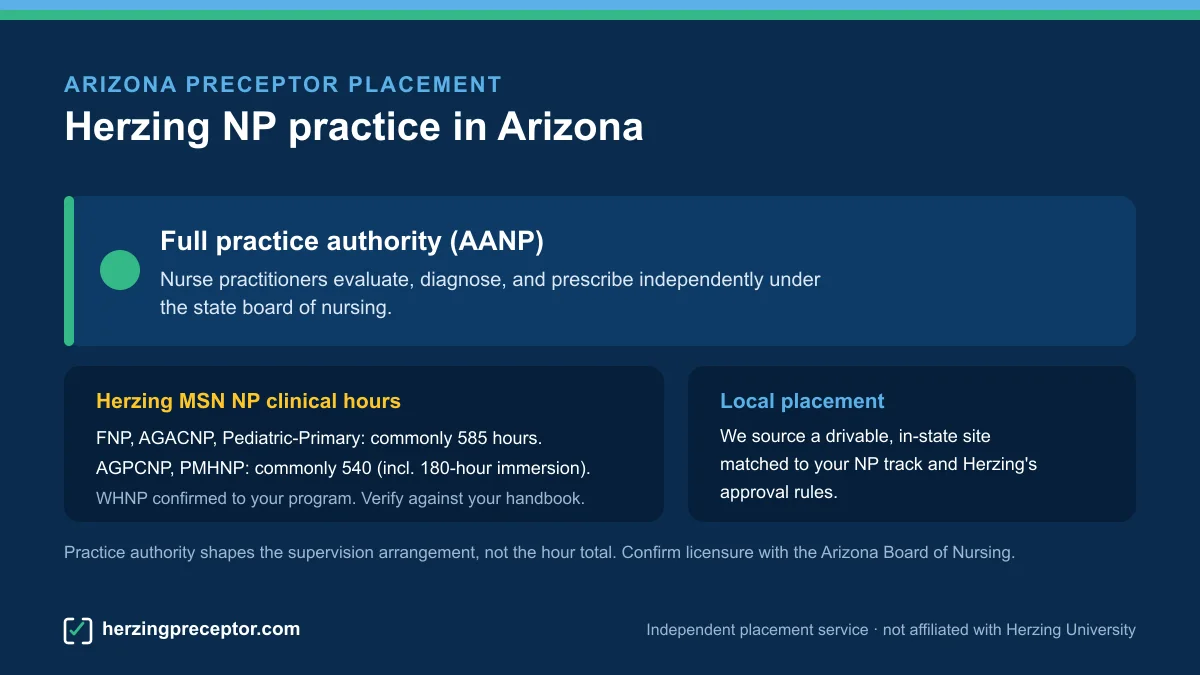
How full practice authority affects the rotation
AANP classifies Arizona as a full practice state. Licensed nurse practitioners may evaluate patients, diagnose, order and interpret tests, and manage treatment, including prescribing, under the authority of the Arizona State Board of Nursing. Arizona has used this model since 2001, and state law does not require a physician collaboration agreement for ordinary NP practice.
For a Herzing student, full practice authority expands the pool beyond physician-led offices. Experienced NPs may own clinics, hold their own patient panels, and decide whether their practice can teach a student. The legal independence of the clinician does not reduce the student's supervision requirement. Clinical work still occurs with an approved preceptor at an approved site.
The candidate must match the course as well as the state license. A family NP in lifespan primary care may fit FNP work, while AGACNP, AGPCNP, PMHNP, PNP-PC, and WHNP experiences require their own population and setting match. The actual visits available during the planned dates matter more than a broad clinic label.
Check credentials with the Arizona State Board of Nursing
The Arizona State Board of Nursing is the official source for nursing licensure, advanced practice requirements, public verification, renewal, and discipline in Arizona. Use its current record before spending weeks on a possible preceptor. A practice website or professional profile may omit a recent change in license status or population certification.
Board verification is a screening step, not Herzing approval. The clinical application generally requires the preceptor's CV and a signed agreement, and Herzing considers whether the clinician, site, patient mix, and supervision fit the course. Ask the site about student policies and credentialing before treating interest as a confirmed rotation.
- Verify current licensure and the relevant population focus
- Confirm the course dates and the clinician's teaching availability
- Ask whether the site can provide the required patients and supervision
Map the Arizona search to real clinical markets
Metro Phoenix has the deepest provider pool, including Phoenix, Mesa, Chandler, Gilbert, Glendale, Peoria, Surprise, and Scottsdale. Tucson supports another large clinical market. NP-owned primary care and psychiatric practices can be useful possibilities in both regions, while the largest systems often use formal student calendars.
Arizona attracts students from many local and online nursing programs, so proximity to a large city does not remove competition. Widening the commute within the Valley or considering Tucson can create options, but the course population and dates must remain the first filters.
A physical placement needs a commute and schedule the student can sustain for the full course. A virtual option needs equally careful screening because the clinician, patient encounters, technology, privacy process, and supervision must all support the learning objectives. Searching by course fit first prevents a nearby but unusable site from consuming the approval window.
Use Herzing support without losing time
Herzing encourages students to identify their own site and preceptor. A Clinical Placement Advisor and a master's-prepared Clinical Coordinator support the process, and an approved-site fallback list may offer leads if the student's search does not produce a workable option. Herzing reviews every proposed clinician and site against the current program and course.
The conditional APRN Clinical Placement Pledge functions as a placement backstop for an eligible student who completes the required steps, meets deadlines, and begins the formal process at least two months before the clinical application deadline. The site and preceptor must satisfy approval requirements. Starting early and documenting outreach protects the student's eligibility and gives review teams useful time.
We focus on the sourcing gap. We contact clinicians by specialty, confirm interest and dates, and organize a candidate for the student to submit through Herzing's process. Matching comes first, and payment is due only when a placement is secured. Current service pricing appears only on the cost page.
Confirm hours, setting, and delivery format
The six Herzing MSN NP tracks are FNP, AGACNP, AGPCNP, PMHNP, PNP-PC, and WHNP. Commonly published totals are 585 clinical hours for FNP, AGACNP, and PNP-PC, and 540 for AGPCNP and PMHNP, including a 180-hour immersion. Use the current handbook and your degree plan to confirm. Do not assign WHNP a fixed total without program-specific confirmation.
Herzing combines online course delivery with supervised, in-person practicum work at an approved clinical site. A telehealth component may be possible if current program, course, site, and state requirements allow it and the encounters meet learning objectives. Our service maintains both physical and virtual preceptorship routes, subject to Herzing's decision about what is acceptable.
Before accepting a candidate, verify current state eligibility for the program and practicum. Plan backward from the clinical application deadline and allow time for the CV, signed agreement, site paperwork, and organizational onboarding. No hours should begin based only on a verbal commitment.
When the Arizona search needs another route
If your calls have reached full schedules, closed student panels, or clinicians outside the required population, request a free placement review. Include the track, course dates, preferred cities, travel radius, and whether a physical or eligible virtual option could work so the next search is based on the actual practicum.
A strong candidate is more than a name and license number. The clinician must be willing to teach, the site must be able to host, the available patients must fit, and Herzing must complete its required review before clinical activity begins.
Good to know
What is the NP practice authority category in Arizona?
AANP classifies Arizona as full practice. That category describes the state framework for licensed NP practice. Herzing students remain supervised and need an approved preceptor and site regardless of the preceptor's degree of independence.
Does Herzing place every NP student in Arizona?
Herzing encourages students to identify a site and preceptor, provides placement staff and an approved-site fallback list, and offers a conditional APRN Clinical Placement Pledge for eligible students who satisfy its steps, timing, and approval conditions.
Can a Herzing practicum in Arizona use telehealth?
Possibly. The Herzing program, course, site, Arizona rules, supervision plan, and patient encounters must permit it. Confirm the proposed virtual component with the program before relying on those encounters for clinical hours.
What paperwork should I expect for a Arizona preceptor?
Plan to obtain the prospective preceptor's current CV and signed agreement, plus accurate site and credential information. Herzing or the clinical organization may request additional items during review and onboarding.
Get matched with a
Herzing-approvable preceptor
Tell us your track, your city, and your clinical application deadline. We'll reply with a placement plan and a realistic path to clearing it.