Finding a Herzing Clinical Preceptor in Georgia
Georgia is an AANP restricted practice state, and that legal framework shapes how clinics organize NP care. A Herzing student also needs a course-specific site, qualified preceptor, workable schedule, and enough time for school review.
Get matched, free
Tell us your track and city. No payment until you’re matched with a preceptor.
How restricted practice authority affects the rotation
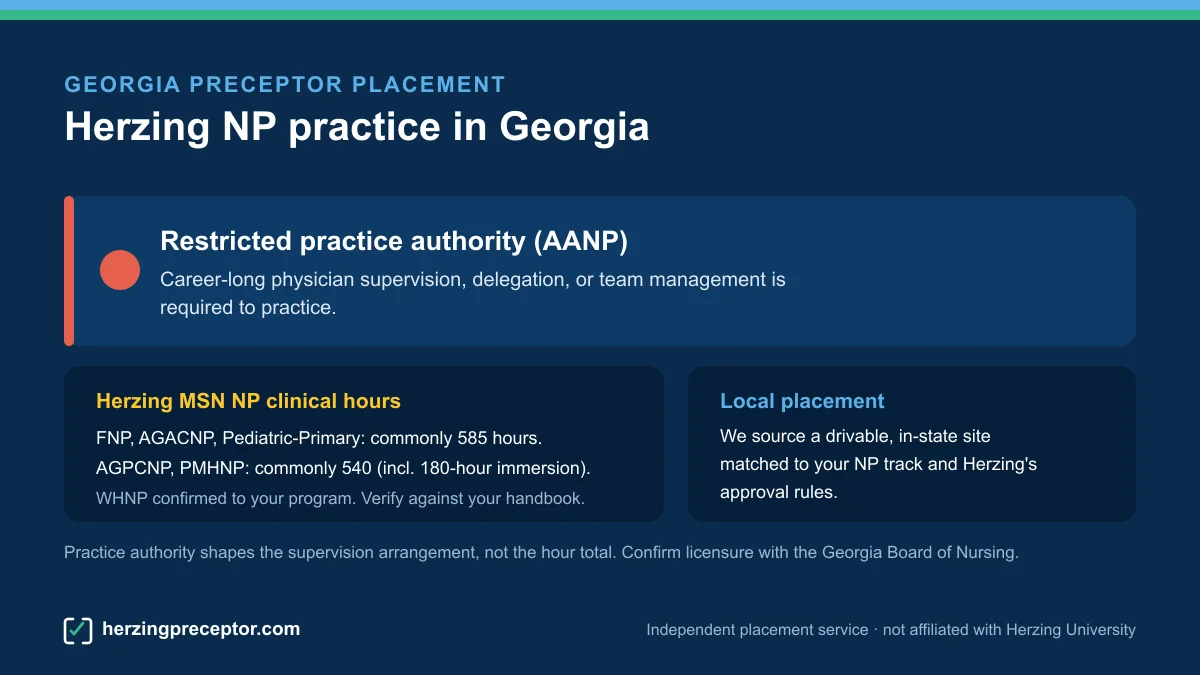
AANP places Georgia in the restricted practice category. A Georgia NP practices and prescribes through a nurse protocol agreement with a delegating physician. The agreement defines delegated medical acts and prescribing authority, and the formal structure remains part of practice throughout the NP's career.
The protocol does not require a physician to attend every visit. Georgia NPs lead primary care panels, urgent care visits, psychiatric medication management, and hospital services within their authorized roles. For a student, the structure often means a clinic has more than one person involved in a decision to host, including the NP, delegating physician, manager, or system education office.
Georgia grants APRN authorization on top of an RN license, while protocol agreements connect with physician regulation. The prospective preceptor's current nursing authorization, national certification, population focus, site privileges, and patient mix all need to be clear before Herzing considers the placement.
Check credentials with the Georgia Board of Nursing
The Georgia Board of Nursing is the official source for nursing licensure, advanced practice requirements, public verification, renewal, and discipline in Georgia. Use its current record before spending weeks on a possible preceptor. A practice website or professional profile may omit a recent change in license status or population certification.
Board verification is a screening step, not Herzing approval. The clinical application generally requires the preceptor's CV and a signed agreement, and Herzing considers whether the clinician, site, patient mix, and supervision fit the course. Ask the site about student policies and credentialing before treating interest as a confirmed rotation.
- Verify current licensure and the relevant population focus
- Confirm the course dates and the clinician's teaching availability
- Ask whether the site can provide the required patients and supervision
Map the Georgia search to real clinical markets
Metro Atlanta has the most sites across Atlanta, Marietta, Decatur, and Lawrenceville, along with the heaviest competition. Augusta, Columbus, Savannah, Macon, and Athens provide large regional markets. Valdosta, Albany, and smaller middle and south Georgia communities can produce primary care or behavioral health possibilities that receive fewer student requests.
An Atlanta-only search may repeatedly reach practices already committed to local programs. A broader Georgia plan can help, but the course and commute must remain workable. Rural clinics often serve complex community needs, while acute care options concentrate around major hospital markets.
A physical placement needs a commute and schedule the student can sustain for the full course. A virtual option needs equally careful screening because the clinician, patient encounters, technology, privacy process, and supervision must all support the learning objectives. Searching by course fit first prevents a nearby but unusable site from consuming the approval window.
Use Herzing support without losing time
The student is encouraged to search for a preceptor and clinical site first. Herzing supplies support through a Clinical Placement Advisor, a master's-prepared Clinical Coordinator, and an approved-site fallback list. School staff determine whether the proposed experience fits the program, course, credentials, and patient population.
Herzing's conditional APRN Clinical Placement Pledge can step in as a placement backstop when an eligible student completes every required action, meets the stated deadlines, and formally starts the process at least two months before the clinical application deadline. The candidate must still meet approval standards. The current policy should guide timing rather than an informal summary from another cohort.
Our placement work begins with the student's track, dates, location, and setting needs. We source specialty-matched clinicians and discuss whether the practice can host before the candidate enters school review. The student pays only after a placement is secured, with process details on how it works and current service pricing on cost.
Confirm hours, setting, and delivery format
Hour planning starts with the exact Herzing track. FNP, AGACNP, and PNP-PC commonly publish 585 clinical hours. AGPCNP and PMHNP commonly publish 540 hours, including a 180-hour immersion. Herzing also offers WHNP, whose current clinical total should be checked for the individual program. Confirm every figure against the current handbook and degree plan.
Coursework being online does not turn the clinical requirement into a home-based experience. Students complete supervised practicum activity at a Herzing-approved site. Telehealth may be included when the program, course, site, state, and patient experience permit it. We search for physical placements and maintain a virtual preceptorship route, while Herzing determines whether a proposed format can count.
Students should confirm that their Herzing track is currently eligible for enrollment and practicum activity in the state. The calendar should cover school review and site credentialing as well as the planned hours. A candidate must provide the right population, setting, and supervision throughout the course.
When the Georgia search needs another route
If your calls have reached full schedules, closed student panels, or clinicians outside the required population, request a free placement review. Include the track, course dates, preferred cities, travel radius, and whether a physical or eligible virtual option could work so the next search is based on the actual practicum.
A strong candidate is more than a name and license number. The clinician must be willing to teach, the site must be able to host, the available patients must fit, and Herzing must complete its required review before clinical activity begins.
Good to know
What is the NP practice authority category in Georgia?
AANP classifies Georgia as restricted practice. That category describes the state framework for licensed NP practice. Herzing students remain supervised and need an approved preceptor and site regardless of the preceptor's degree of independence.
Does Herzing place every NP student in Georgia?
Herzing encourages students to identify a site and preceptor, provides placement staff and an approved-site fallback list, and offers a conditional APRN Clinical Placement Pledge for eligible students who satisfy its steps, timing, and approval conditions.
Can a Herzing practicum in Georgia use telehealth?
Possibly. The Herzing program, course, site, Georgia rules, supervision plan, and patient encounters must permit it. Confirm the proposed virtual component with the program before relying on those encounters for clinical hours.
What paperwork should I expect for a Georgia preceptor?
Plan to obtain the prospective preceptor's current CV and signed agreement, plus accurate site and credential information. Herzing or the clinical organization may request additional items during review and onboarding.
Get matched with a
Herzing-approvable preceptor
Tell us your track, your city, and your clinical application deadline. We'll reply with a placement plan and a realistic path to clearing it.