Build a workable Herzing clinical plan in Louisiana
Louisiana is a reduced practice state under the current AANP category. Herzing NP students can still build strong clinical experiences there, but a successful search accounts for the preceptor's collaborative practice structure, the site's student process, and Herzing approval before the practicum begins.
Get matched, free
Tell us your track and city. No payment until you’re matched with a preceptor.
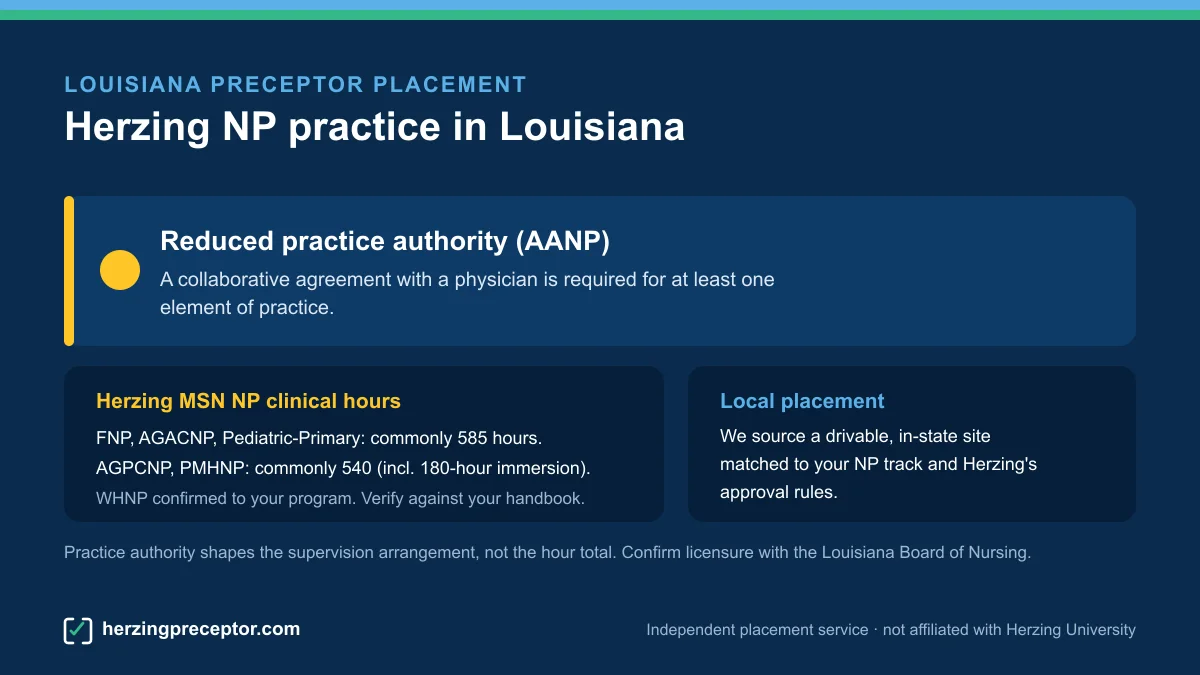
Reduced practice shapes the clinic conversation
AANP classifies Louisiana as a reduced practice state. Nurse practitioners provide assessment, diagnosis, testing, treatment, and prescribing within state requirements that include a documented physician collaboration structure. The details belong to the clinician and practice, but they affect who has authority to accept a student and which leaders may need to review the request.
Day to day, Louisiana NPs manage substantial patient care across primary care, behavioral health, acute care, pediatrics, and women's health. Reduced practice does not turn every visit into direct physician supervision. It means the organization has a defined arrangement behind the NP's practice. A student should ask how that arrangement affects scheduling, student participation, documentation, and access to the patient population required by the course.
State practice authority does not decide whether a Herzing practicum is academically suitable. A current license, the correct population focus, enough relevant visits, a willing site, and Herzing review all matter. Confirm current program eligibility for Louisiana before committing to travel, onboarding, or a proposed preceptor.
Use the Louisiana State Board of Nursing first
The Louisiana State Board of Nursing, or LSBN, licenses registered nurses and advanced practice registered nurses and publishes the state's advanced practice materials. Its official site is the right place to verify a potential NP preceptor's license and to read current rules. A clinic biography or professional directory can help identify a lead, but it should not replace the Board record.
Check the exact name on the license, current status, APRN role, and any information relevant to the proposed specialty. Then compare those facts with Herzing's preceptor requirements and the course objectives. The Board establishes the person's authority to practice in Louisiana. Herzing decides whether that person, site, and experience fit the student's program.
Search Louisiana by region and patient population
New Orleans and its surrounding parishes offer the broadest mix of health systems, community clinics, psychiatric services, specialty offices, and independent practices. Baton Rouge provides another large clinical market. Lafayette and Lake Charles support Acadiana and southwest Louisiana, while Shreveport and Bossier City anchor the northwest. Monroe and Alexandria can open regional options that a New Orleans-only search misses.
Houma, Hammond, Slidell, and communities along the river and bayou corridors may support family, pediatric, women's health, or behavioral health experiences. Smaller organizations sometimes reach a decision locally, but their staffing can limit how many students they accept. Ask about patient ages, visit types, weekly volume, preceptor availability, and any affiliation or onboarding process before treating an interested clinician as a complete placement.
Search by the work the course requires. An FNP student needs a broad primary care population, a PMHNP student needs appropriate psychiatric evaluation and management, and an AGACNP student needs an acute care environment. Herzing's specialties guide can help translate a track into a clear request for a Louisiana practice.
Herzing uses a student-first placement process
Herzing encourages students to identify their own site and preceptor. Support includes a Clinical Placement Advisor, a master's-prepared Clinical Coordinator, and an approved-site fallback list. Once a Louisiana clinician is interested, prepare the preceptor's CV and signed preceptor agreement, then follow the current application and compliance instructions. Do not begin clinical activity until Herzing has approved the arrangement.
The conditional APRN Clinical Placement Pledge is a placement backstop. It can step in after the student completes the required steps, meets the applicable deadlines, begins the formal process at least two months before the clinical application deadline, and proposes a site and preceptor that satisfy Herzing requirements. The clinical placement guide and clinical deadlines page explain why early documentation matters.
Translate published hours into a Louisiana calendar
Herzing has six MSN NP tracks: FNP, AGACNP, AGPCNP, PMHNP, PNP-PC, and WHNP. FNP, AGACNP, and PNP-PC commonly publish 585 clinical hours. AGPCNP and PMHNP commonly publish 540 hours, including a 180-hour immersion. Confirm the current handbook and your individual plan before setting a schedule. Do not assign an hour number to WHNP without current program confirmation.
Hours are easier to plan by course, patient population, and available clinic days. Ask whether the preceptor can support the full term, how holidays affect access, and whether another approved site may be needed for a later specialty experience. Keep clinical tracking and compliance records in the systems Herzing currently directs you to use, and review approved totals frequently rather than waiting until the course closes.
Compare physical and virtual routes carefully
Online coursework is paired with an in-person, precepted practicum at a Herzing-approved site. Telehealth may be a supervised component when the program, course, site, state, patient population, and planned activities allow it. A Louisiana practice's use of video visits does not by itself establish what an individual course will count.
Our service offers both physical placement and virtual preceptorship routes. Confirm the proposed format, preceptor, site, patient encounters, and activities with Herzing before relying on the plan. The format should support the course objectives and the Louisiana clinician's authorized practice.
Get help with a focused Louisiana search
If direct outreach has stalled, we can source specialty-aligned Louisiana prospects, confirm interest and schedule fit, and organize the match details for school review. We match first, and payment is due only when a placement is secured, with service pricing on the cost page. Share your track, region, travel range, course dates, and patient-population needs in a free placement review.
Good to know
Is Louisiana a full practice state for nurse practitioners?
No. AANP currently places Louisiana in the reduced practice category. Students should use the LSBN for current state rules and ask Herzing whether the proposed preceptor and site fit the specific course.
What paperwork should a Louisiana preceptor expect?
The application includes the preceptor's CV and a signed preceptor agreement. The site may add its own onboarding items, and the student should follow the current Herzing clinical application and compliance instructions.
How many clinical hours are commonly published for Herzing NP tracks?
FNP, AGACNP, and PNP-PC commonly publish 585 hours. AGPCNP and PMHNP commonly publish 540 hours, including a 180-hour immersion. Confirm the current handbook, and obtain current program guidance for WHNP hours.
Can a Louisiana telehealth practice support a Herzing practicum?
Telehealth may be part of an approved experience when Louisiana rules, the program, course, site, and planned activities allow it. Confirm the individual physical or virtual route with Herzing before beginning.
Get matched with a
Herzing-approvable preceptor
Tell us your track, your city, and your clinical application deadline. We'll reply with a placement plan and a realistic path to clearing it.