Plan a Herzing clinical search across Michigan
Michigan is a restricted practice state in the current AANP framework. Herzing students can find valuable preceptors across its large clinical markets, but the state's delegation structure, long travel distances, and system-level student processes should be built into the search from the beginning.
Get matched, free
Tell us your track and city. No payment until you’re matched with a preceptor.
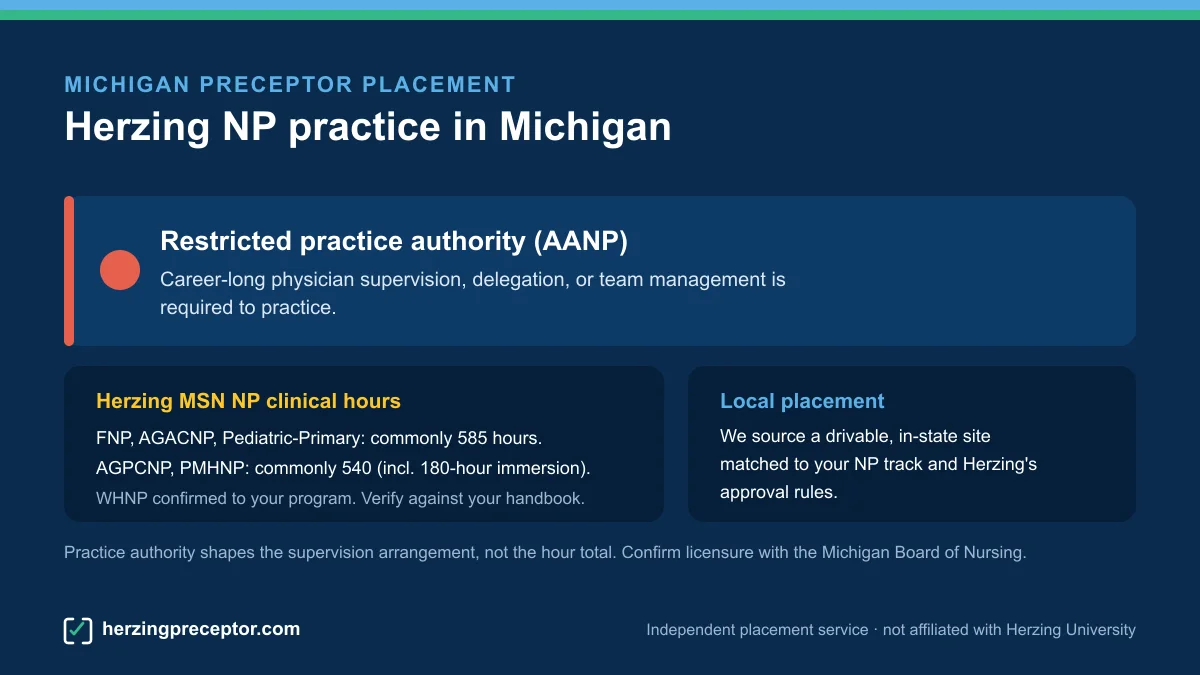
Restricted practice affects how Michigan clinics operate
AANP classifies Michigan as a restricted practice state. Nurse practitioners hold nursing licensure and specialty certification, while parts of advanced practice operate through physician involvement and delegation under Michigan law. Controlled-substance prescribing is one area where the clinician's authorization and practice structure matter.
That does not mean a physician stands beside the NP during every patient visit. Michigan NPs assess, diagnose, treat, educate, coordinate, and prescribe within their authorized arrangements. A student may see independent clinical decision making alongside a documented delegation process. Ask the practice how those responsibilities affect the student role, chart review, and access to relevant encounters.
Restricted practice defines the licensed environment, not the quality of a practicum. A strong placement still comes from a properly credentialed preceptor, a suitable patient population, consistent supervision, and activities that Herzing approves. Confirm current program eligibility for Michigan before relying on any proposed site.
Use LARA and the Michigan Board of Nursing for verification
The Michigan Board of Nursing operates within the Department of Licensing and Regulatory Affairs, commonly called LARA. The state licenses registered nurses and grants advanced practice specialty certifications. Its official nursing pages and MiPLUS services provide the current source for applications, guidance, and credential lookup.
Verify a prospective preceptor by exact legal name and check the active credential, specialty certification, and any public status information. Then confirm national certification, actual practice focus, patient ages, and weekly availability. Herzing's preceptor requirements should be reviewed alongside the state record because licensure alone does not establish academic fit.
Build separate strategies for Michigan's regions
Metro Detroit has the broadest provider pool. Detroit, Dearborn, Southfield, Troy, Warren, and the wider Wayne, Oakland, and Macomb county area include health systems, primary care groups, psychiatric practices, urgent care, and specialty clinics. Ann Arbor offers academic and community settings, although student demand is intense around major institutions.
Grand Rapids anchors western Michigan, with Kalamazoo and Battle Creek adding regional options. Lansing, Flint, Saginaw, and Bay City can support central and mid-Michigan searches. Traverse City serves much of the northern Lower Peninsula. In the Upper Peninsula, Marquette is the largest hub, while students in smaller communities may need a wider drive radius and a weather-conscious schedule.
Contact the department that actually manages students. Large systems may route requests through clinical education rather than an individual provider. Smaller practices may make decisions locally but have limited staff. State the track, course, dates, expected activities, and patient needs so the practice can determine fit without guessing.
Move through Herzing's student-first process in order
Herzing encourages students to identify their own site and preceptor. The Clinical Placement Advisor and master's-prepared Clinical Coordinator help with the process, and an approved-site fallback list may provide another route. Begin with your professional network and workplace, then widen by specialty and region if those contacts do not fit.
Once a clinician is interested, collect the preceptor's CV and signed preceptor agreement and follow current clinical application instructions. A Michigan facility may add orientation, health, background, privacy, or affiliation requirements. Keep those site steps separate from school review, and do not begin practicum activities before the full arrangement is approved.
Keep the Placement Pledge conditions visible
The conditional APRN Clinical Placement Pledge can serve as a backstop after the student completes required tasks, meets each deadline, starts the formal process at least two months before the clinical application deadline, and pursues a site and preceptor that satisfy Herzing requirements. It works best as part of an early plan, not as a final-week substitute for outreach.
Michigan organizations may use student application windows that close before the Herzing deadline. Track both calendars. Save outreach results, advisor messages, CV status, agreement signatures, and compliance tasks so questions can be answered quickly. The clinical deadlines page helps organize those checkpoints.
Make the commonly published hours operational
Herzing's MSN NP tracks are FNP, AGACNP, AGPCNP, PMHNP, PNP-PC, and WHNP. FNP, AGACNP, and PNP-PC commonly publish 585 clinical hours. AGPCNP and PMHNP commonly publish 540 hours, including a 180-hour immersion. Confirm the current handbook and your degree plan before arranging a Michigan schedule. WHNP students should obtain the current hour requirement from Herzing.
Plan one course at a time. Confirm clinic days, patient volume, population focus, preceptor leave, and the activities you can complete. A site that fits an early primary care course may not fit a later specialty or acute course. Keep clinical tracking and compliance tools generic and follow the systems Herzing currently assigns.
Describe physical and virtual participation accurately
Online coursework is paired with an in-person, precepted practicum at a Herzing-approved site. Telehealth may be a supervised component where Michigan rules, the site, program, course, patient population, and learning activities permit it. Explain how the preceptor supervises remote encounters and which objectives still require physical access.
Our service offers physical placement and virtual preceptorship routes. Confirm the individual format, site, preceptor, and activities with Herzing before starting. A hybrid Michigan practice should be proposed through its actual workflow rather than described as entirely one format.
Get help with a Michigan search that has stalled
We can source Michigan prospects by track, region, commute, dates, and patient requirements, then organize the match information for school review. We match first, and payment is due only when a placement is secured, with service terms on the cost page. Share the cities and schedule you can realistically support in a free placement review.
Good to know
Is Michigan a restricted practice state for NPs?
Yes. AANP currently places Michigan in the restricted category. Students should use LARA for current state rules and confirm that Herzing approves the specific preceptor, site, and course plan.
Where can I verify a Michigan NP preceptor?
Use Michigan's official LARA and MiPLUS resources to check the nursing license and advanced practice credential. Also confirm national certification, patient population, and current practice role.
What does the Michigan clinical application need from the preceptor?
Herzing requires the preceptor's CV and signed preceptor agreement. The site may add its own onboarding and compliance documents, so identify the correct education or practice contact early.
Can telehealth be part of a Michigan Herzing practicum?
It may be an approved supervised component when Michigan rules, Herzing, the course, site, and activities allow it. Confirm the physical or virtual route and what the program will count before beginning.
Get matched with a
Herzing-approvable preceptor
Tell us your track, your city, and your clinical application deadline. We'll reply with a placement plan and a realistic path to clearing it.