Build a Herzing clinical search across North Carolina
North Carolina is a restricted practice state in the current AANP framework. Nurse practitioners deliver extensive care across the state, while required physician supervision and joint regulatory oversight shape the practice structure a Herzing student should understand before proposing a site.
Get matched, free
Tell us your track and city. No payment until you’re matched with a preceptor.
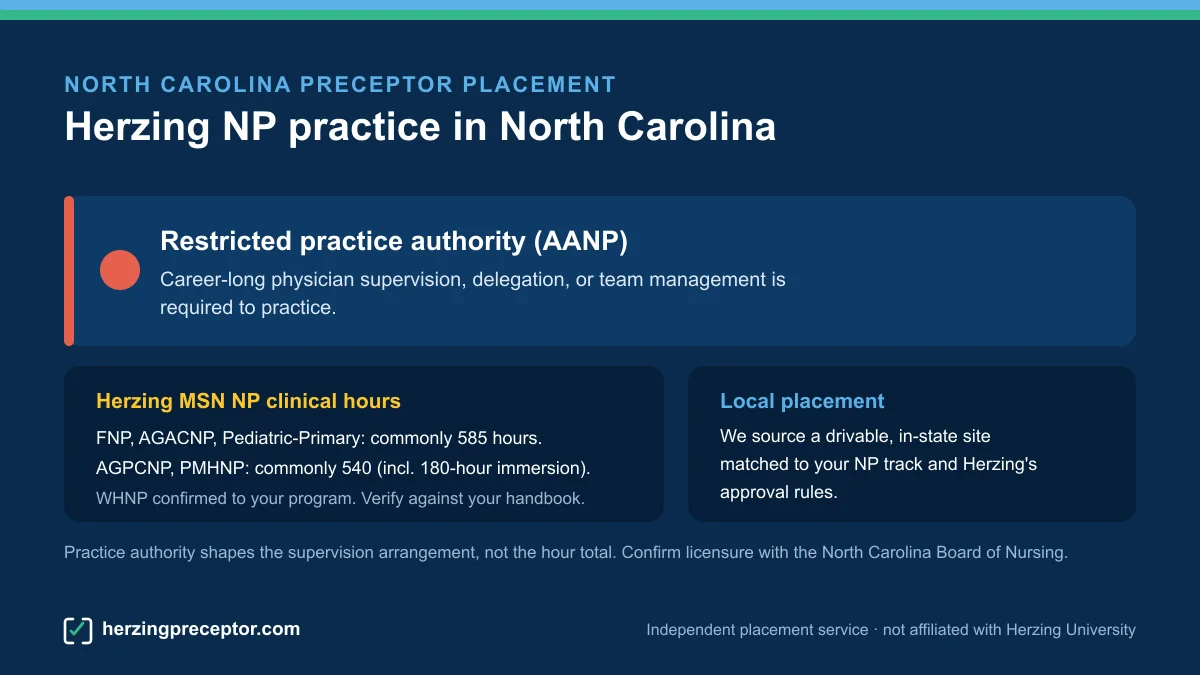
Restricted practice shapes North Carolina NP arrangements
AANP classifies North Carolina as a restricted practice state. Nurse practitioners are jointly regulated by the North Carolina Board of Nursing and the North Carolina Medical Board and practice through a required supervising physician arrangement. Current state guidance should be used to understand the specific approval and practice requirements.
In daily care, North Carolina NPs assess patients, diagnose, manage treatment, educate families, coordinate referrals, and prescribe within their authorized practice arrangement. Restricted practice does not necessarily mean the supervising physician is physically present for every encounter. It does mean the formal structure is important and may influence protocols, prescribing, review, and site operations.
A student needs to understand that context without assuming it establishes academic fit. Confirm the proposed preceptor's specialty, patients, credentials, schedule, supervision approach, and site role. Verify current Herzing program eligibility in North Carolina and obtain approval for the specific course arrangement.
Start credential review with the North Carolina Board of Nursing
The North Carolina Board of Nursing maintains an official nurse practitioner section with applications, rules, guidance, and credential services. Because the state uses joint regulation for NP practice, follow the Board's current information rather than relying on an employer description or an old summary from another source.
Search the clinician by exact legal name and verify active nursing and nurse practitioner authority. Then confirm national certification, current specialty, patient ages, supervising arrangement, and actual work site. Compare those findings with Herzing's preceptor requirements and the assigned course objectives.
Search within North Carolina's distinct clinical regions
Raleigh, Durham, and Chapel Hill form a major Triangle market with academic systems, community organizations, independent groups, behavioral health, pediatrics, primary care, and specialties. Competition for student capacity is substantial, and large organizations often require a central application rather than an agreement made solely with a clinician.
Charlotte has another large and diverse clinical market. Greensboro, Winston-Salem, and High Point support the Triad, while Asheville and Boone are useful western hubs. Rocky Mount and other eastern communities can broaden a search, and Wilmington anchors a southeastern and coastal market. Smaller communities may offer valuable continuity but fewer matching preceptors.
Define the course need before choosing the region. In each inquiry, state the track, patient population, setting, dates, weekly availability, and paperwork required from the preceptor. Ask whether the organization accepts outside students and whether an education, credentialing, or affiliation office must approve the request.
Use Herzing's student-first process from the beginning
Herzing encourages students to identify their own clinical site and preceptor. The Clinical Placement Advisor and master's-prepared Clinical Coordinator assist with the process, and an approved-site fallback list may provide another option. Begin with professional contacts, employers, and trusted local introductions, then widen the search by region and course fit.
When a North Carolina clinician is willing to be reviewed, obtain the preceptor's CV and signed preceptor agreement and complete the current clinical application. The site may separately require health records, background screening, privacy training, orientation, or affiliation review. Both Herzing approval and facility onboarding should be complete before clinical activity begins.
Plan around every Placement Pledge condition
The conditional APRN Clinical Placement Pledge requires the student to complete assigned actions, meet deadlines, begin the formal process at least two months before the clinical application deadline, and pursue a site and preceptor that satisfy Herzing approval requirements. Major North Carolina systems may set their own student deadlines much earlier.
Keep dated records of outreach, replies, advisor guidance, CV collection, signed agreements, and facility steps. If a Triangle system cannot accept the requested term, early action leaves time to consider the Triad, Charlotte, the coast, western North Carolina, or a community site that still meets the course population.
Make commonly published hours workable by course
Herzing offers MSN NP tracks in FNP, AGACNP, AGPCNP, PMHNP, PNP-PC, and WHNP. FNP, AGACNP, and PNP-PC commonly publish 585 clinical hours. AGPCNP and PMHNP commonly publish 540 hours, including a 180-hour immersion. Confirm the current handbook and personal degree plan before committing to dates. WHNP students should obtain the current hour requirement from Herzing.
Ask a site about clinic days, eligible encounters, patient ages, expected volume, preceptor leave, and schedule changes. A long drive may still work when hours are concentrated on consistent days. It becomes risky when the plan depends on scattered short shifts or a patient population the practice sees only occasionally.
Clarify physical and virtual routes before the start
Herzing's online coursework is paired with an in-person, precepted practicum at a Herzing-approved site. Telehealth may be a supervised component when North Carolina requirements and the program, course, site, patient population, supervision, and activities permit it. The practice arrangement and student supervision should be accurately described in the proposal.
Our service offers physical placement and virtual preceptorship routes. Confirm the individual format with Herzing before beginning. A hybrid North Carolina clinic may offer useful remote encounters, but the student should verify which objectives and hours require physical presence.
Add focused sourcing to a North Carolina search
We can source North Carolina prospects according to track, course, region, commute, dates, and patient requirements, then organize the proposed match for school review. We match first, and payment is due only once a placement is secured. Terms are listed on the cost page. Tell us which regions work in a free placement review.
Good to know
Is North Carolina a restricted practice state for NPs?
Yes. AANP currently places North Carolina in the restricted practice category. The North Carolina Board of Nursing provides current guidance for the state's jointly regulated NP framework.
Where do I verify a North Carolina NP preceptor?
Use the North Carolina Board of Nursing's official credential and nurse practitioner resources. Also confirm national certification, specialty, patient population, supervising arrangement, and Herzing course fit.
Which North Carolina regions should be included in a search?
The Triangle, Charlotte, the Triad, Asheville, Boone, Wilmington, and eastern communities can all provide options. Choose a travel radius that remains sustainable for the full course.
Can telehealth be part of a North Carolina Herzing practicum?
It may be a supervised component when state requirements and Herzing, the course, site, patient population, and activities allow it. Confirm the physical or virtual route before beginning.
Get matched with a
Herzing-approvable preceptor
Tell us your track, your city, and your clinical application deadline. We'll reply with a placement plan and a realistic path to clearing it.