How Herzing NP Students Can Find an Ohio Preceptor
Ohio is a reduced practice state where certified nurse practitioners work within a standard care arrangement. That legal structure shapes clinic decisions, while Herzing's student-first process governs the academic placement.
Get matched, free
Tell us your track and city. No payment until you’re matched with a preceptor.
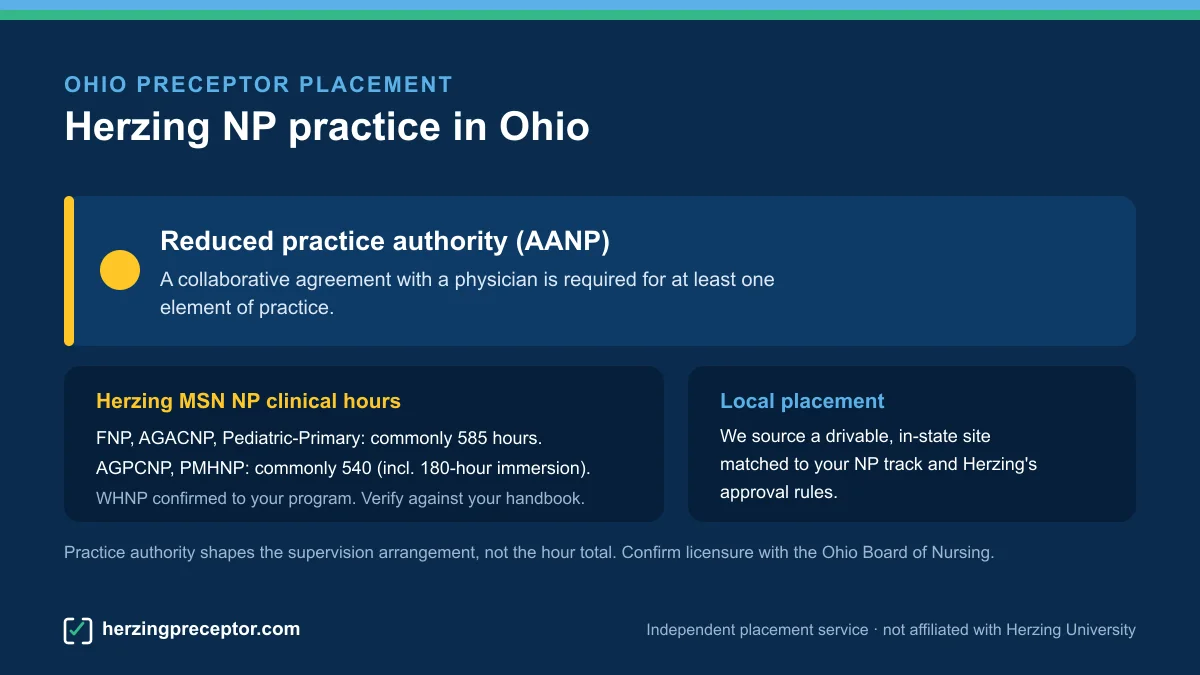
Reduced practice in Ohio means a written collaboration framework
AANP classifies Ohio as a reduced practice state. Ohio certified nurse practitioners provide assessment, diagnosis, testing, treatment, and prescribing within their preparation, but state law requires a standard care arrangement with a collaborating physician or podiatrist. The document addresses consultation, referral, prescribing, and coverage when the collaborator is unavailable.
A standard care arrangement is not constant bedside supervision. An experienced NP may manage a full schedule and make daily clinical decisions while practicing within that legal framework. For a student search, the practical effect is that the interested NP may need a collaborating clinician, practice manager, or health system to approve the addition of a learner.
Students do not create their own standard care arrangements. They work under an approved preceptor and site plan. Ask who has authority to accept students, whether the organization has a clinical education office, and what internal deadlines apply before treating a clinician's interest as a complete placement.
Check the Ohio Board of Nursing and the actual specialty
The Ohio Board of Nursing licenses nurses and APRNs, publishes practice guidance, and participates in Ohio's public eLicense system. Verify the prospective NP's active credential and role through the official system. If a physician or podiatrist is proposed as the preceptor, use the relevant Ohio licensing record for that profession.
An active license does not establish course fit by itself. Review population focus, national certification, current patient panel, and practice setting. For psychiatric clinicals, confirm genuine psychiatric scope. For acute care, confirm the site supports complex adult and older-adult care. Use Herzing's preceptor requirements to organize the academic questions before outreach.
Treat Ohio as several placement markets
Columbus has a deep mix of family care, pediatrics, behavioral health, specialty offices, and hospital services, but it also draws students from many programs. Search beyond the central medical districts into surrounding communities. Cleveland, Akron, Canton, and Youngstown form a broad northeast corridor where acute, primary, and specialty options sit across several separate systems.
Cincinnati and Dayton anchor southwest Ohio, while Toledo is the natural starting point for the northwest. Athens, Marietta, Zanesville, and communities in Appalachian Ohio may offer community practices with broad patient continuity, although travel and limited student capacity require careful planning. A wider radius often produces more useful leads than repeated calls in one ZIP code.
Ask each organization about student windows, site agreements, compliance items, and schedule capacity. Large systems can have firm application cycles. Smaller offices may decide faster but still need a complete preceptor file. Confirm current Herzing program eligibility for Ohio clinical activity before committing to a location or cross-border plan.
Build the Herzing file while the site completes onboarding
Herzing encourages students to identify their own clinical site and preceptor. A Clinical Placement Advisor and a master's-prepared Clinical Coordinator support that work, and the university maintains an approved-site fallback list. When a clinician agrees, request the current CV and signed preceptor agreement promptly. Collect accurate site information and respond to follow-up questions before the clinical application deadline.
The APRN Clinical Placement Pledge is a conditional backstop tied to the Clinical Guidance Process. Students must complete the required steps, meet deadlines, begin the formal process at least two months before the clinical application deadline, and present arrangements that meet Herzing approval requirements. Review the current conditions with your advisor and work backward from the actual term calendar.
The school file and the Ohio site's onboarding may move at different speeds. Keep a simple checklist with an owner and due date for every document. If a health system requires its own review, submit early enough to address corrections without losing the term.
Fit the Ohio site into the full clinical sequence
Herzing's six MSN NP tracks are FNP, AGACNP, AGPCNP, PMHNP, PNP-PC, and WHNP. FNP, AGACNP, and PNP-PC commonly publish 585 clinical hours. AGPCNP and PMHNP commonly publish 540 hours, including a 180-hour immersion. Confirm all figures, course order, and setting rules against the current Herzing handbook before planning a term.
Ohio's large markets can support multiple specialties, but one site may not cover the entire program. An FNP plan needs lifespan primary care. AGPCNP focuses on adult and older-adult primary care, while AGACNP needs acute and complex care. PNP-PC needs a pediatric outpatient population, and PMHNP needs psychiatric patients across the required ages and conditions. WHNP students should confirm the current hour and setting requirements directly with the program.
Coursework may be online, but the practicum is in person and precepted at a Herzing-approved site. Plan each rotation as its own specialty match and leave space for a different preceptor when later objectives change.
Choose a physical or virtual route before the calendar tightens
We offer physical placement and virtual preceptorship routes. Physical placement can draw from several Ohio metros and a realistic commute corridor. A virtual route may include supervised telehealth where the program, site, course, and state allow it. Confirm what the individual Herzing course will count before building a schedule around remote encounters.
Our search focuses on specialty fit, clinician interest, site readiness, and the documents needed for review. Students are matched before payment is due, and payment is due only after a placement is secured. Service pricing stays on the cost page.
For an Ohio plan based on your real dates and availability, request a free placement review. Include your track, current course, city, travel radius, clinical deadline, and any site conversations already underway.
Good to know
Is Ohio a reduced practice state for nurse practitioners?
Yes. AANP classifies Ohio as reduced practice. Certified nurse practitioners use a standard care arrangement with a collaborating physician or podiatrist.
Does an Ohio standard care arrangement supervise the student?
No. It governs the licensed NP's professional practice. The student follows the approved preceptor, site, course, and Herzing clinical plan.
When should I begin the Herzing placement process?
Start well before the clinical application deadline. The conditional Pledge requires the formal process to begin at least two months before that deadline, along with completion of its other conditions.
Can an Ohio telehealth placement count?
A supervised telehealth component may count where the course, program, site, and state allow it. Confirm the approved format and documentation before relying on those hours.
Get matched with a
Herzing-approvable preceptor
Tell us your track, your city, and your clinical application deadline. We'll reply with a placement plan and a realistic path to clearing it.