Finding a Pennsylvania Preceptor for Herzing NP Clinicals
Pennsylvania is a reduced practice state where certified registered nurse practitioners work in collaboration with physicians. That framework can add decision-makers to a student placement, especially in larger organizations.
Get matched, free
Tell us your track and city. No payment until you’re matched with a preceptor.
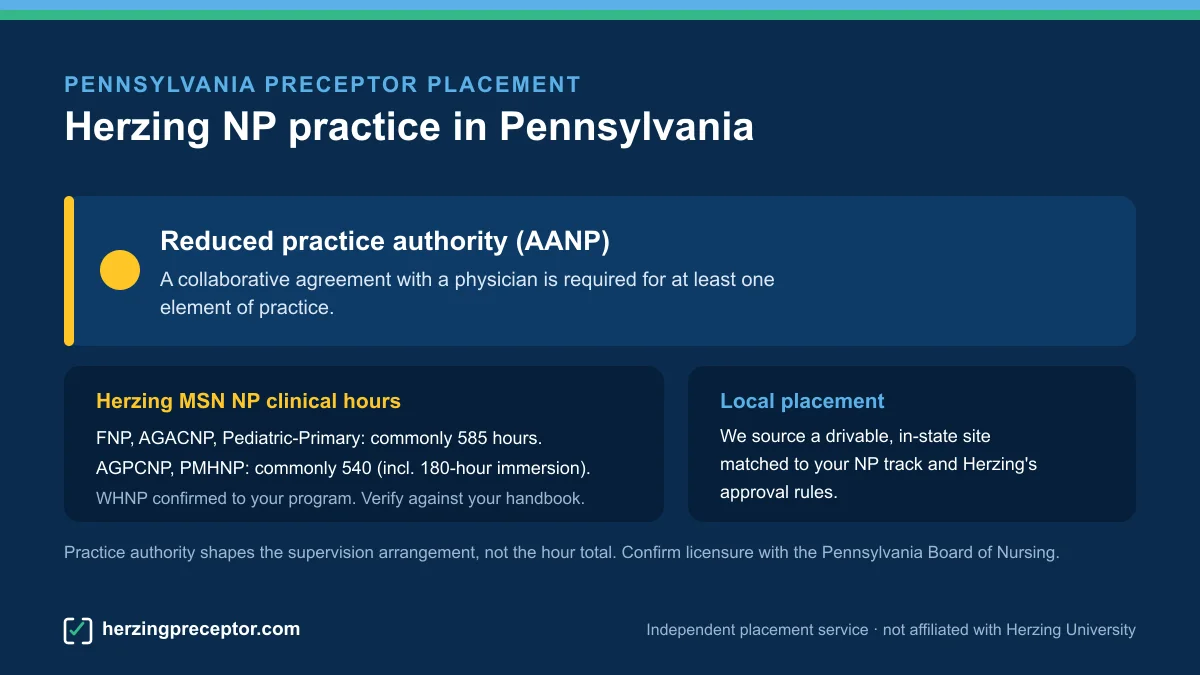
Pennsylvania collaboration rules shape the clinical setting
AANP categorizes Pennsylvania as a reduced practice state. Pennsylvania certified registered nurse practitioners, commonly called CRNPs, diagnose and provide therapeutic care in collaboration with licensed physicians. Current state practice information includes a career-long written collaboration structure, with additional prescriptive authority agreements applying to prescribing practice.
Collaboration does not mean a physician watches each visit. A CRNP may manage a patient panel and make day-to-day clinical decisions while the written framework supports consultation and referral. During a student search, the arrangement can mean that the interested CRNP needs approval from collaborating physicians, clinical leadership, or the employer before taking a learner.
Students practice through the approved educational relationship rather than signing the provider's collaboration agreement. Ask who controls student acceptance, whether the site has a school review process, and whether both the preceptor and organization can support the proposed dates.
Verify the credential with the Pennsylvania State Board of Nursing
The Pennsylvania State Board of Nursing regulates nursing credentials, CRNP practice, prescriptive authority, and discipline. Use the state's official verification resources to confirm an active license and the advanced practice credential. Check physician preceptors through the appropriate Pennsylvania board.
A valid license is only the first screen. Confirm the clinician's certification, specialty, patient ages, clinical setting, and time to teach. Compare the match with Herzing's preceptor requirements and request a current CV early. A famous health system does not make a specialty mismatch academically useful.
Divide Pennsylvania into workable search regions
Philadelphia and its surrounding counties offer extensive primary care, specialty, pediatrics, behavioral health, and hospital services. Large systems may have formal student cycles, so include community practices in Montgomery, Bucks, Delaware, and Chester counties. Allentown, Bethlehem, and Easton form the Lehigh Valley market, while Scranton and Wilkes-Barre anchor the northeast.
Pittsburgh and Allegheny County provide another deep clinical region, with options extending into surrounding western counties. Harrisburg, Hershey, Lancaster, and York create a strong south-central corridor. Erie serves the northwest, and State College supports central Pennsylvania. Rural students may need to work along a highway corridor rather than search only in their home county.
A cross-state commute into New Jersey, Delaware, Maryland, Ohio, or West Virginia introduces a different license jurisdiction and a separate location for Herzing to assess. Confirm program eligibility and site location rules before assuming a nearby border practice can be used.
Make the student-first process a documented process
Herzing encourages NP students to identify their own preceptor and site. Support comes through a Clinical Placement Advisor, a master's-prepared Clinical Coordinator, and an approved-site fallback list. When a clinician agrees, gather the current CV and signed preceptor agreement, then provide complete site and contact information for the clinical application.
The APRN Clinical Placement Pledge is a conditional backstop. Students must complete the required steps, meet deadlines, start the formal placement process at least two months before the clinical application deadline, and put forward a site and preceptor that meet Herzing requirements. Review the current guidance with the advisor rather than using a prior cohort's dates.
Pennsylvania health systems may require their own affiliation review, credentialing, health records, training, or fixed application. Keep school and site tasks visible in one timeline. A signed preceptor agreement helps, but organizational approval and the university decision still need to be completed before the experience begins.
Map the commonly published hours to different settings
Herzing offers MSN NP tracks in FNP, AGACNP, AGPCNP, PMHNP, PNP-PC, and WHNP. FNP, AGACNP, and PNP-PC commonly publish 585 clinical hours. AGPCNP and PMHNP commonly publish 540 hours, including a 180-hour immersion. Confirm the current handbook, course sequence, and exact requirements before assigning hours to any Pennsylvania site.
FNP needs lifespan primary care, while AGPCNP focuses on primary care for adults and older adults. AGACNP generally requires acute and complex adult care. PNP-PC requires appropriate pediatric primary care, and PMHNP needs psychiatric scope and patient access that support the immersion. WHNP students should confirm current hours and settings directly with Herzing before selecting a practice.
The coursework may be online, but clinical learning is an in-person, precepted practicum at a Herzing-approved site. Pennsylvania's broad health markets can support several rotations, yet one provider may not fit every course. Plan a sequence rather than forcing all objectives into the first available clinic.
Select the service route that fits the course
We offer a physical placement route across Pennsylvania and a virtual preceptorship route for supervised telehealth opportunities where the program, course, site, and state allow them. Virtual care can widen access for some specialties, but students should confirm what their individual Herzing course will count before relying on it.
Our search evaluates specialty alignment, geographic feasibility, clinician interest, schedule, and site readiness. A student is matched first and payment becomes due only when a placement is secured. Pricing details remain on the cost page.
If a local search has produced interest but no complete file, request a free placement review. Share the track, course, Pennsylvania region, travel limit, available days, clinical deadline, and any health system already contacted.
Good to know
Is Pennsylvania a reduced practice state?
Yes. AANP classifies Pennsylvania as reduced practice. CRNPs practice through a physician collaboration framework, with prescriptive authority requirements applying where relevant.
Can a Pennsylvania CRNP precept a Herzing student?
Potentially. The CRNP needs the right active credentials, specialty, patient population, schedule, and site permission, followed by Herzing review for the course.
What are strong Pennsylvania search regions?
Philadelphia, Pittsburgh, the Lehigh Valley, Harrisburg-Hershey, Lancaster-York, Scranton-Wilkes-Barre, Erie, and State College are useful anchors for different specialties.
Does virtual preceptorship replace an in-person Pennsylvania practicum?
It should not be assumed to replace the in-person practicum. Supervised telehealth may be considered where the individual course, program, site, and state permit it.
Get matched with a
Herzing-approvable preceptor
Tell us your track, your city, and your clinical application deadline. We'll reply with a placement plan and a realistic path to clearing it.