Planning a Wisconsin Preceptor Search for Herzing
AANP classifies Wisconsin as reduced practice under the framework in effect in July 2026. A state law change takes effect September 1, 2026, so students should verify live guidance for the date of the proposed rotation.
Get matched, free
Tell us your track and city. No payment until you’re matched with a preceptor.
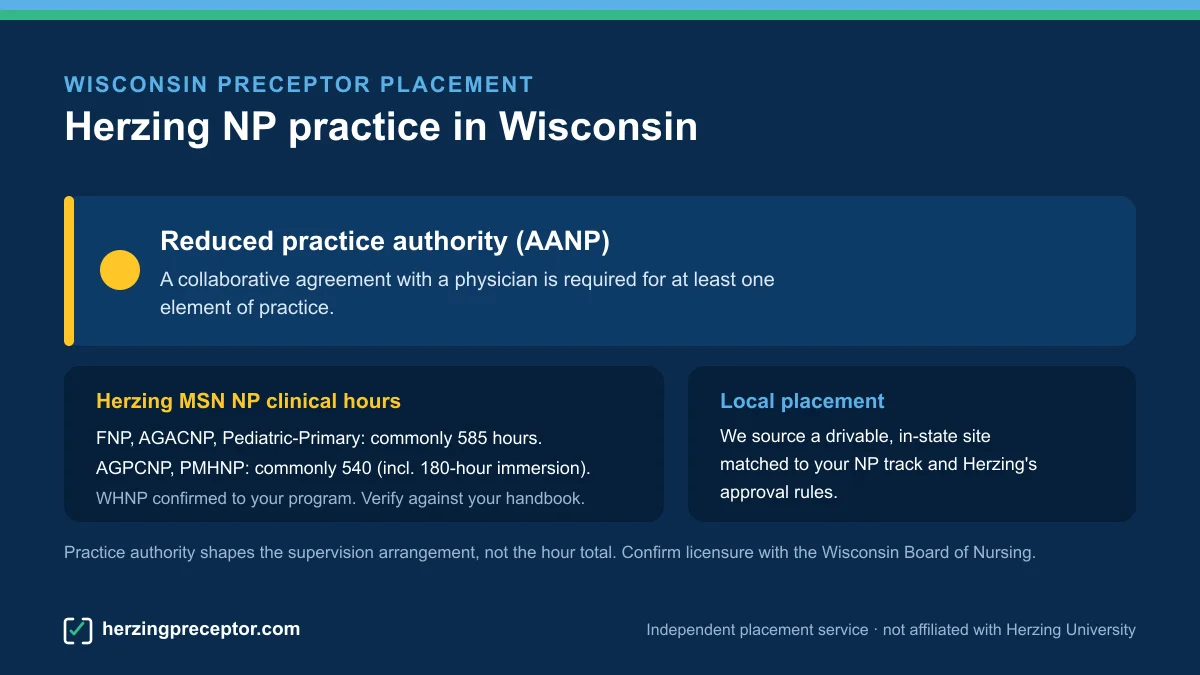
Wisconsin practice rules are in a transition period
AANP lists Wisconsin as a reduced practice state under the rules in effect in July 2026. The current framework uses the Advanced Practice Nurse Prescriber credential and requires a documented collaborative relationship with a physician or dentist. Collaboration supports consultation and care but does not mean constant observation of every visit.
Wisconsin's Department of Safety and Professional Services says the APRN Modernization Act takes effect on September 1, 2026 and includes changes related to independent practice. A student planning a later rotation should use the live state page for the rule that applies at that time rather than relying on an older summary.
The regulatory change does not remove the need for a supervised student experience. Verify how the clinician is credentialed on the rotation date, then assess specialty, patient population, site, schedule, and teaching capacity for the Herzing course.
Verify APNP credentials through Wisconsin DSPS
The Wisconsin Board of Nursing operates through the Department of Safety and Professional Services. DSPS publishes APNP information, rules, credential lookup, and disciplinary resources. Confirm the provider's active nursing and APNP status, relevant certification, and current public record.
Next, compare the provider with Herzing's preceptor requirements. Ask about patient ages, diagnoses, clinical setting, weekly volume, supervision, and site permission. Request a current CV and identify who can sign the preceptor agreement and organizational documents.
Search Wisconsin through its regional care centers
Milwaukee and surrounding counties offer extensive primary, acute, pediatric, psychiatric, women's health, and specialty care. Madison provides another deep market with academic, community, and public-sector settings. Both areas attract many students, making application timing and smaller community practices worth considering.
Green Bay and the Fox Cities, including Appleton, Neenah, and Oshkosh, form a strong northeast corridor. Eau Claire, La Crosse, Wausau, and Superior anchor other regions. Students in northern or central rural areas may need a wider drive and flexible weekdays for psychiatric or acute care placements.
Search by course population before distance, and calculate winter travel for repeated shifts. Confirm current Herzing program eligibility for Wisconsin clinical activity. A Minnesota, Michigan, Iowa, or Illinois site introduces another location and licensing jurisdiction for review.
Start Herzing and site review before a rule change or deadline
Herzing encourages students to identify a site and preceptor. A Clinical Placement Advisor and master's-prepared Clinical Coordinator support the process, and an approved-site fallback list offers another option. After a clinician is interested, collect a current CV, signed preceptor agreement, exact site details, and the proposed schedule.
The APRN Clinical Placement Pledge is a conditional backstop. Students must complete required steps, meet deadlines, begin the formal placement process at least two months before the clinical application deadline, and present a preceptor and site that meet Herzing approval requirements. Confirm the current conditions with the advisor.
Wisconsin organizations may use central student applications, affiliation review, privacy training, health records, and background documentation. Keep these tasks aligned with the university file. If a state credential status could change before the term, verify it again near submission and follow current DSPS guidance.
Use commonly published hours to plan the specialty sequence
Herzing offers MSN NP tracks in FNP, AGACNP, AGPCNP, PMHNP, PNP-PC, and WHNP. FNP, AGACNP, and PNP-PC commonly publish 585 clinical hours. AGPCNP and PMHNP commonly publish 540 hours, including a 180-hour immersion. Confirm current totals and course requirements in the Herzing handbook.
Milwaukee and Madison may support specialty and acute care depth. Community practices across the state can provide continuity for family and adult primary care. PNP-PC and PMHNP students should confirm patient ages and reliable volume. WHNP students should verify current program hours and setting rules before selecting a women's health site.
Online coursework is paired with an in-person, precepted practicum at a Herzing-approved site. Plan each course as a separate patient population and setting decision, even if one Wisconsin clinician may support more than one term.
Consider physical and virtual pathways under current rules
Our physical placement route searches Wisconsin by specialty and travel radius. Our virtual preceptorship route may identify supervised telehealth where the current state rules, site, program, and course allow it. Confirm what the individual Herzing course will count before including remote encounters.
We screen credentials, patient population, schedule, site readiness, and candidate documents in both routes. Students are matched before payment, and payment is due only when a placement is secured. Pricing information remains on the cost page.
Request a free placement review with your track, course, Wisconsin location, travel limit, available days, and target term. We will evaluate the appropriate regional, physical, or virtual route using the current requirements.
Good to know
Is Wisconsin a reduced practice state?
AANP classifies Wisconsin as reduced practice under the July 2026 framework. DSPS says a modernization law takes effect September 1, 2026, so check current guidance.
Where are Wisconsin's main clinical markets?
Milwaukee, Madison, Green Bay, the Fox Cities, Eau Claire, La Crosse, Wausau, and Superior provide different regional options for NP specialties.
Should I verify the preceptor more than once?
Yes when a credential or practice rule may change before the rotation. Use current DSPS records during screening and again as needed during the clinical application process.
Can a Wisconsin placement include supervised telehealth?
It may be considered where current state rules, the site, program, and course allow it. Confirm the accepted format and hours with Herzing before relying on it.
Get matched with a
Herzing-approvable preceptor
Tell us your track, your city, and your clinical application deadline. We'll reply with a placement plan and a realistic path to clearing it.